Learn how to build bone density and improve heart health with strength training.
No, you won’t get bulky.
“Strength training helps maintain and combat the loss of muscle mass by increasing muscular fitness as well as improving function in our daily lives,” said Brad Awalt, manager of Vanderbilt Health’s employee wellness program, Health Plus.
Here, we dish out the benefits of lifting weights, and offer some go-to moves to get started.
Research shows pumping iron makes for healthy bones.
“Resistance or strength training can prevent osteoporosis by augmenting bone mineral density. Improving muscular fitness is very important for enhancing quality of life,” said Awalt, a certified health fitness specialist with the American College of Sports Medicine. Losing bone density means bones get weaker. That increases someone’s chances of getting fractures.
One or two weight-training workouts every week can go a long way toward aging gracefully.
Keep your waistline in check
A Harvard study showed strength training was more successful than aerobic activity for keeping participants’ stomachs trim. Waist circumference isn’t just about vanity, either — health professionals say the girth of your tummy says a lot about your overall wellness.
“Although cardio exercise should be the primary focus for weight loss, regular resistance training should be included for a more rounded exercise routine,” Awalt said. The American College of Sports Medicine recommends that resistance training should be done at least two days every week, with eight to 12 repetitions of eight to 10 different exercises that target all the major muscle groups, he added.
Keep your heart healthy
Running on a treadmill or spending an hour on the elliptical isn’t the only way to keep your heart in tip-top shape. An Appalachian State University study showed that just 45 minutes of strength training lowered subjects’ blood pressure up to 20 percent. “Regular resistance training can decrease the risk of heart disease by lowering body fat, decreasing blood pressure, improving cholesterol and lowering the stress placed on the heart while lifting a particular load,” Awalt said.
Improve your flexibility
Strength training exercises that use a full range of motion for each joint can improve your flexibility as much as stretching does. University of North Dakota researchers tested participants’ flexibility before and after completing strength training or static stretching programs. Those who lifted improved their flexibility just as much as the people who only did a stretching routine.
Say goodbye to achy joints
Contrary to popular belief, squatting down to full depth won’t stress your knee joints — in fact, the muscles built during strength training with support your joints, reducing pain. Squat on!
Getting started
Your best bet to get started with strength training is getting quality in-person instruction. This can be in a class (check your gym’s schedule for one that includes strength training), at a functional fitness gym (yes, beginners are welcome) or with a trainer. Small group or personal training, though the priciest option, ensures you’ll get the attention you need.
Can’t spare the expense? If you’re learning on your own, do your homework. The American College of Sports Medicine provides a guide. Use reputable fitness sites to find how-tos. YouTube videos are particularly helpful for beginners; choose videos produced by well trained, certified fitness professionals.
Keep in mind: Doing any kind of resistance training regularly – a few times a week, every week – matters more than what type of activity you choose. Resistance or strength training can mean working out with resistance bands, for example, or following YouTube videos of no-equipment, bodyweight-only exercises, or lifting heavy barbells. In 2026 the American College of Sports Medicine updated its resistance training guidelines to emphasize that sticking with any type of this training consistently is key to all the health gains that strength training promises. You don’t need a rigid or intimidating routine to reap the benefits.
Try it out
Let’s start with the basics. Remember, start with only light weights while you’re learning each movement. Challenge yourself with heavier weight only once you feel comfortable.
- Goblet squat: Set your feet shoulder-width apart. Hold a kettlebell or a dumbbell in both hands at your chest. With control and keeping your chest up, push your hips down and back as you lower yourself to a squatting position. Allow your knees to track over your toes until your thighs are parallel to the floor. Push from your heels to stand back up.
- Overhead press: Bring two dumbbells to your shoulders. Take a deep breath in and tighten your abdominal muscles. Press both arms straight up, in line with your ears. Then lower the weights back down to starting position.
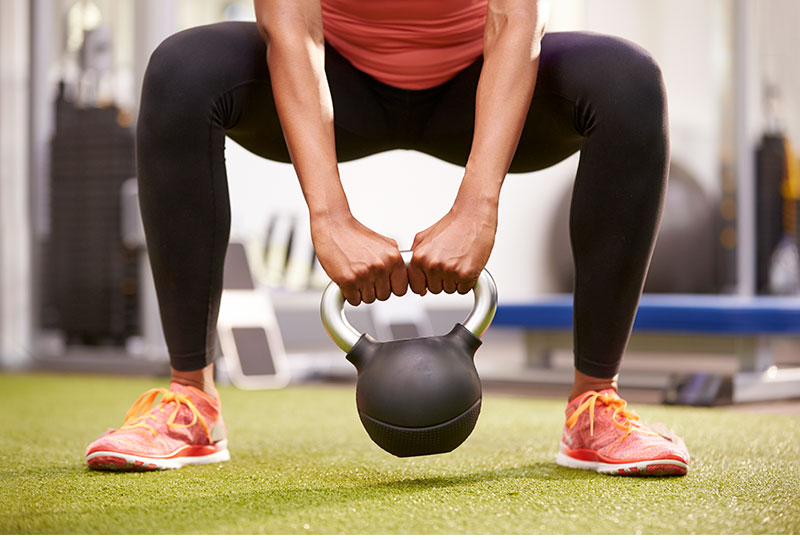
- Kettlebell sumo deadlift: Stand with feet shoulder-width apart and toes slightly turned out, with a kettlebell between your feet. Bend at the hips and grab the kettlebell handle. Flatten your back, keeping your neck neutral. Press your feet into the floor and stand up.